The Hand Inside the Equation
A live gallery of interactive media studies
Each study takes a craft or a phenomenon that has been described by mathematics and hands the equation back to you: drop ink on water, bend light around a black hole, or watch your own face turn into letters. The maths runs live on the GPU, and an equation card can show the exact formula behind your last gesture.
Running live. Open a study from the gallery; the camera study asks before it uses your camera, and the picture never leaves your device.
01 · Suminagashi
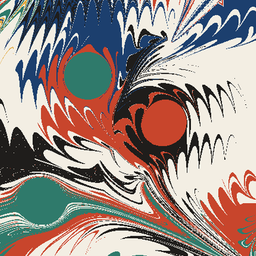
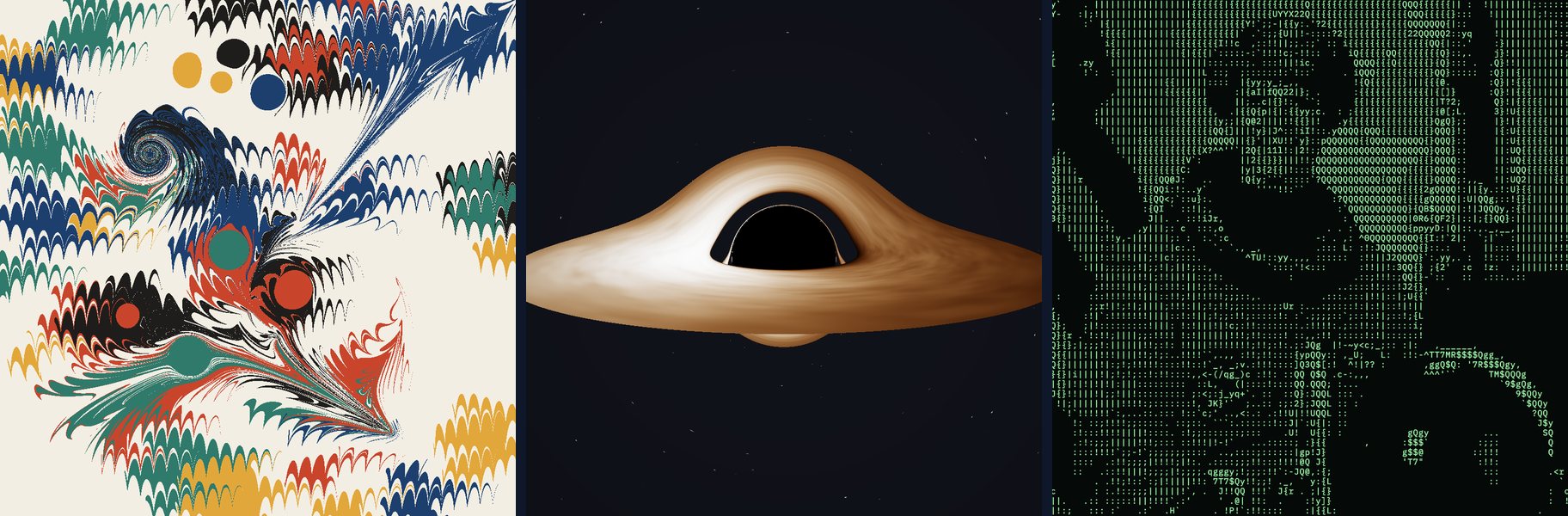
Japanese and Turkish paper marbling, rebuilt from its maths. Every drop, comb and swirl is an exact, reversible transformation of the water's surface, so the GPU can draw the pattern pixel by pixel.
02 · Photon Sphere
Light bending around a black hole: Einstein's orbit equation traced for every pixel, beside a paper diagram that draws the ray behind the pixel you point at. Switch to Newton to see half the bending.
03 · Textmode Mirror
Your camera, drawn only in letters. Drag sideways to squint until the letters become a face, type your name to draw with its letters, and compare three ways of choosing each character.
Checked, not claimed
- Marbling's maths on the GPU was checked against an independent Python reference, pixel by pixel, away from ink edges.
- Light bending matches the exact orbit integral to a median 1.5 parts per million, and finds the critical impact parameter √27⁄2 to within 0.001%.
- Einstein vs Newton: far from the hole, light bends 2.007 times as much as Newton predicts, the factor of two the 1919 eclipse confirmed.
- The black hole's shadow measures 2.60 times the horizon, within 0.012% of the closed-form size.
- Text images: the shape-matching method picks the same character as the reference in 99.9–100% of cells, and scores about 1.8 times higher on image similarity up close than the classic method.
- Smooth: a quality governor holds 60 frames per second by lowering resolution under load, and recovers when it can.
No accessibility violations found by axe at phone and desktop sizes. Keyboard, reduced motion and touch all work. Tests with first-time visitors and on a range of phones are next.